RESEARCH DIGEST / GHRH ANALOG · DAC + NO-DAC
CJC-1295 is a long-acting GHRH analog whose DAC chemistry buys a multi-day half-life.
A dark readout of the published record: the tetrasubstituted hGRF(1-29) backbone, the albumin bioconjugation that extends duration, and the human pharmacokinetic studies that measured it. Every quantitative claim is cited.
The chronology
What the CJC-1295 literature has measured
CJC-1295 is a synthetic long-acting analog of growth-hormone-releasing hormone (GHRH), built on the first 29 residues of human GH-releasing factor and engineered to outlast the native peptide by days rather than minutes. In healthy adults, single subcutaneous doses of 30 or 60 micrograms per kilogram produced dose-dependent 2- to 10-fold increases in mean plasma growth hormone for six days or more, and 1.5- to 3-fold increases in IGF-1 for nine to eleven days; after multiple doses, IGF-1 stayed above baseline as long as 28 days [1].
That duration is the whole point of the molecule. The estimated plasma half-life of the long-acting variant was 5.8 to 8.1 days [1] — a figure no unmodified GHRH fragment approaches. It comes from two layers of engineering: four protease-resistant amino-acid substitutions at positions 2, 8, 15, and 27 that block dipeptidylpeptidase-IV cleavage, and a covalent tether to circulating serum albumin. The chemistry is the story this site reads.
The molecule has a precise identity. CJC-1295 carries CAS number 863288-34-0 and a peptide molecular weight near 3367.9 daltons before albumin conjugation; after conjugation, the effective circulating species is the much larger peptide-albumin complex of roughly 66 kilodaltons. That structural specificity is why analytical chemists can pin it down: high-resolution LC-MS/MS definitively identified CJC-1295 as the active ingredient in an unknown 'GHRH' pharmaceutical preparation seized in an anti-doping context [6].
CJC-1295 is an unapproved research chemical. It carries no approved human indication anywhere, and the human evidence base is limited to small early-phase pharmacokinetic studies. What follows is an editorial digest of that record — the structure, the mechanism, the dose-response data, and the open gaps — organized as a track-list of the literature.
CJC-1295 as a GHRH Analog
As a GHRH analog, CJC-1295 is a class member alongside sermorelin and the approved drug tesamorelin: all three are synthetic versions of the hypothalamic hormone that tells the pituitary to release growth hormone. The shared scaffold is hGRF(1-29), the N-terminal 29-residue fragment that retains full GH-releasing activity. What separates CJC-1295 from its relatives is how long it survives in plasma. Native GHRH is cleaved within minutes by dipeptidylpeptidase-IV; CJC-1295's four substitutions block that cleavage, and the DAC variant's albumin tether extends residence to a multi-day scale [1] [2].
How CJC-1295 Works at the Molecular Level
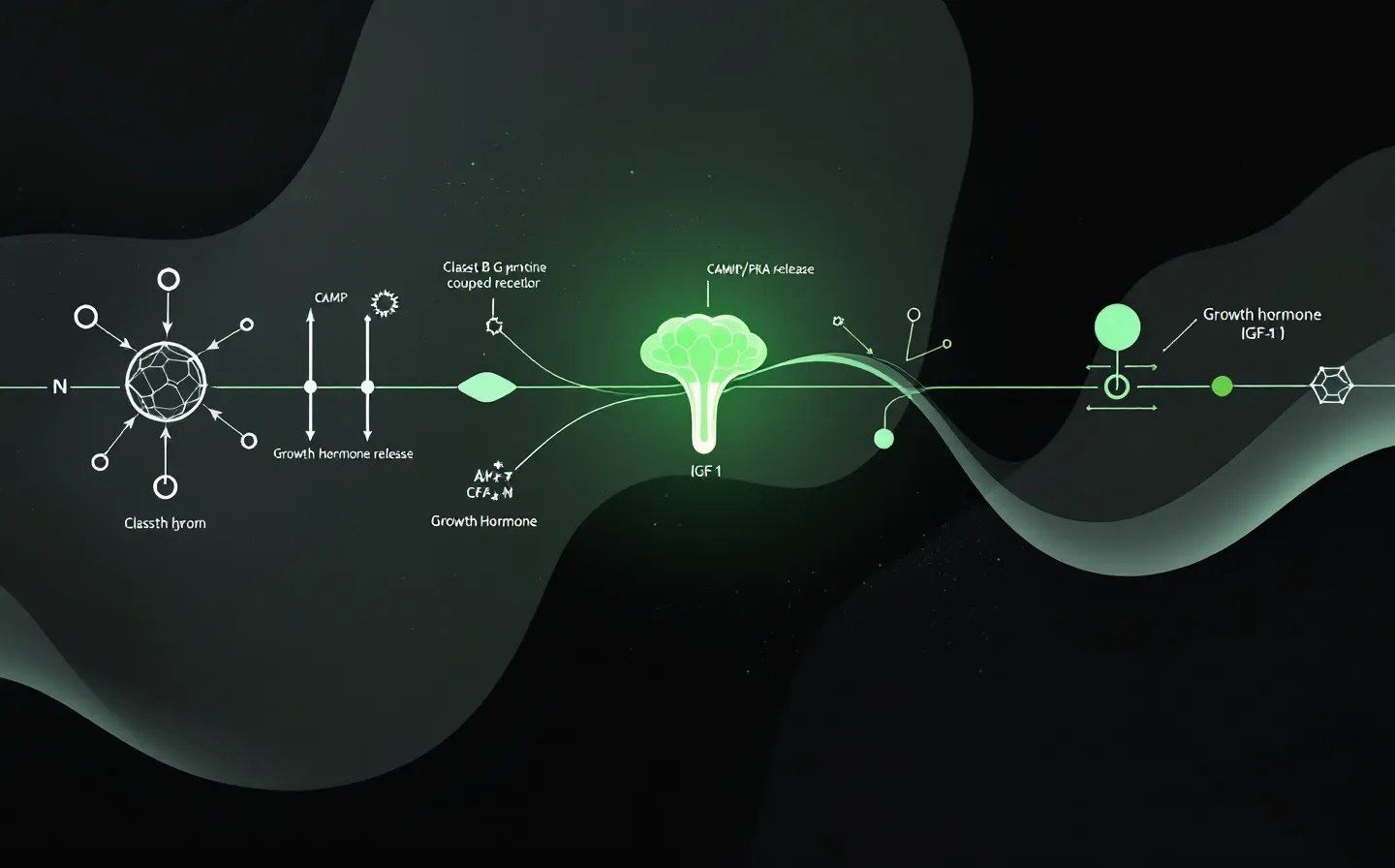
CJC-1295 binds the GHRH receptor — a class B G-protein-coupled receptor — on anterior-pituitary somatotrophs, activating Gs/cAMP/PKA signaling that drives growth-hormone gene transcription and pulsatile GH release, which in turn raises hepatic IGF-1. Cryo-EM structures have since resolved how peptide agonists engage and activate the GHRH receptor, clarifying the receptor conformations these analogs stabilize [7].
The receptor step is the same one native GHRH uses; CJC-1295 simply occupies it for far longer. Because the signaling chain runs receptor to cAMP to GH to IGF-1, the readout researchers measure is downstream: serum GH first, then IGF-1 over the following days. That cascade is the spine of every study summarized here.
What CJC-1295 Does
In published studies, CJC-1295 produces dose-dependent, sustained elevations of growth hormone and IGF-1. In a GHRH-knockout mouse, 2 micrograms given once every 24 hours fully normalized body weight and length and raised pituitary GH mRNA, while dosing every 48 to 72 hours was progressively less effective — direct evidence that the long-acting analog's once-daily schedule is sufficient to restore GH-axis-dependent growth [4].
The albumin-conjugation chemistry was validated earliest in rats: the lead compound showed a 4-fold increase in GH area-under-the-curve over two hours versus the unconjugated peptide, with the albumin conjugate detectable in plasma beyond 72 hours [2]. The pattern that the molecule lengthens exposure and amplifies the GH signal held from the first rodent screen onward.
What the Research Examines
Rather than promising outcomes, the literature examines what stimulating the GH/IGF-1 axis with a long-acting GHRH analog actually does to measurable endpoints. The primary readouts are plasma growth hormone and IGF-1 over time; a proteomic study in 11 healthy young men added candidate biomarkers, finding reproducible serum-protein shifts that correlated linearly with IGF-1 [5].
The honest framing is that these are early measurements, not endorsements. There is no large human efficacy trial and no long-term safety data; a ConjuChem Phase 2 trial in HIV-associated visceral obesity was discontinued and the DAC program did not advance [1]. The interest in CJC-1295 is mechanistic, and that is exactly the register this digest keeps. See the published human research for the study-by-study record.
CJC-1295 as a Research Peptide
As a research peptide, CJC-1295 is supplied lyophilized and is handled in laboratory settings — reconstituted with bacteriostatic water and refrigerated. Oral bioavailability is negligible, so the route used in every study is injection. The compound is also a recurring subject of analytical chemistry: high-resolution LC-MS/MS definitively identified CJC-1295 as the active ingredient in an unknown 'GHRH' pharmaceutical preparation seized in an anti-doping context [6], and it is prohibited at all times in sport under WADA Section S2. The two practical distinctions to keep straight are the CJC-1295 DAC vs no-DAC forms and the resulting CJC-1295 half-life.
Read the report matrix before the mechanism
A plain-language pre-read of real-world reports now flags attribution limits before the technical record begins.